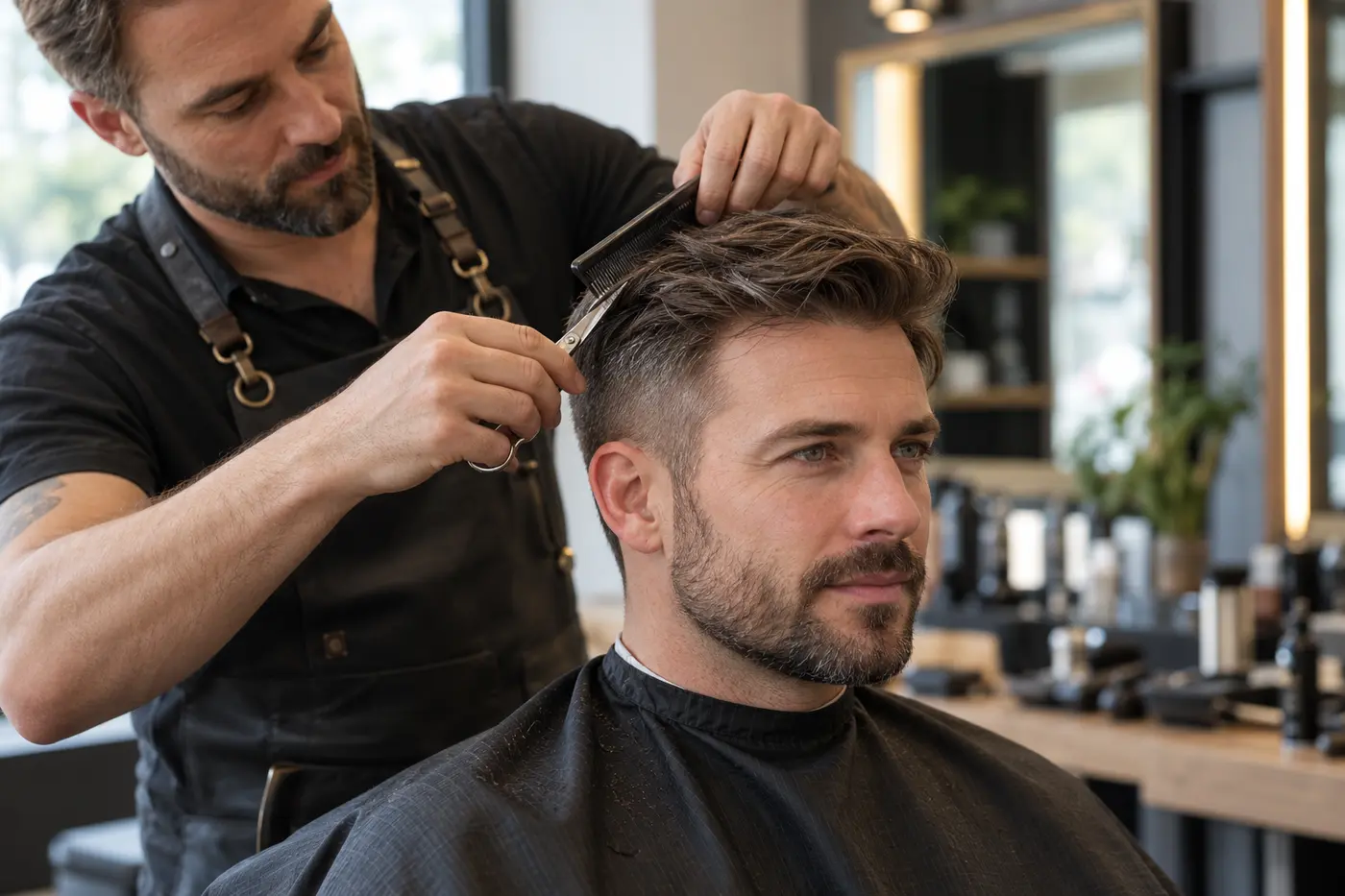
First-time wearers usually have less room for error with an experienced local stylist. Once your base template, placement, density and haircut are proven, an online pre-cut service can make repeat orders faster and more predictable.
First, separate three different services
“Pre-cut” is often used loosely. Before paying, check which of these the seller actually means:
| Service | What is changed | What can still be needed |
|---|---|---|
| Base cut | The base is trimmed to your template or measurements | Haircut, blending, placement and attachment |
| Haircut / styling | The system hair is cut into a selected style | Base fitting, blending and possible local refinement |
| Salon-prepared | May combine base cut, haircut, styling and attachment preparation | Final placement and blending may still vary by service |
Side-by-side comparison
| Factor | Online pre-cut | Local salon cut-in |
|---|---|---|
| Convenience | Arrives closer to ready to wear | Requires an appointment |
| Blend with side hair | Based on photos and instructions | Adjusted while the system is on your head |
| Base placement | Depends on accurate template and measurements | Can be checked in person before final cutting |
| Correction during cutting | No live feedback | Stylist can shorten gradually and reassess |
| Repeat-order consistency | Strong once a proven specification is saved | Can vary by stylist or appointment |
| Return flexibility | May be reduced after alteration | You can inspect the unaltered unit first |
When a pre-cut service makes sense
- You already have a base template that fits reliably.
- You know the exact finished length, density and style that work for you.
- You can send clear front, side and back photos of a successful previous cut.
- The seller confirms exactly what is included and how the service affects returns.
- You need consistency across repeat orders or do not have a suitable local stylist.
Lordhair currently publishes haircut and styling services, including selected pre-styled systems. LaVivid says it offers base-cut and styling options, while Superhairpieces markets a salon-prepared service that can combine several preparation steps. These services are not identical, so compare the included work rather than the headline alone.
When a local salon cut-in is worth it
- This is your first system or first time using a new base size.
- Your surrounding hair has a difficult curl, cowlick, recession pattern or color blend.
- You want a short fade, exposed hairline or another style with little margin for error.
- You are unsure where the front hairline should sit.
- You want to inspect the unaltered unit before making a potentially non-returnable change.
The key word is experienced. A capable barber may still be unfamiliar with hair-system density, base edges and the fact that removed hair cannot grow back. Ask specifically about cut-ins, not only ordinary men's haircuts.
Use our guide to finding and briefing a hair-system barber before ordering.
Compare the total cost—not only the haircut fee
Published online service prices can look inexpensive, but the final comparison should include any base-cut fee, styling fee, extra processing time, shipping, local touch-up and the cost of replacing a unit if the specification is wrong. Lordhair currently advertises a $40 haircut service and LaVivid references a separate $15 base-cut option; verify current checkout pricing because services and promotions can change.
Confirm color, base and density before authorizing irreversible work.
Send measurements and photos from the successful unit.
Choose a forgiving length and allow room for local correction.
What to send for an online pre-cut
- Base template and measurements with the front clearly marked.
- Natural-light photos from the front, both sides, back and above.
- A reference haircut plus a photo of your own successful result, if available.
- Finished lengths for the top, front, crown and sides—not only “short” or “medium.”
- Styling direction including part, fringe, lift and exposed hairline.
- Written confirmation of the base cut, haircut, styling and return-policy consequences.
Mistakes that create expensive problems
- Confusing base cutting with haircutting. They solve different problems.
- Submitting only a celebrity photo. The same style may not work with your density, curl or side hair.
- Ordering the final length too short. Extra length gives a local stylist room to blend; missing length cannot be restored.
- Authorizing alterations before checking color and base. The product may become harder or impossible to return.
- Choosing a barber without asking about systems. Blending a hairpiece requires different planning from a standard haircut.
Frequently asked questions
Should a first-time buyer choose a pre-cut system?
A local cut-in is usually the safer starting point when fit and placement have not been proven. Pre-cut becomes more attractive once you can copy a successful system and haircut.
What is the difference between base cutting and a haircut?
Base cutting trims the material to the bald-area template. A haircut shapes the hair. Some sellers offer them separately, so confirm exactly what you are buying.
Can a pre-cut hair system be returned?
Maybe, but alteration often changes return eligibility. Read the current policy and get written confirmation before authorizing cutting, coloring or styling.
Can any barber perform a cut-in?
A conventional barber may be able to help, but experience with hair systems reduces risk. Ask about base edges, density blending, attachment and previous cut-ins before booking.
Buying online? Plan the cut before checkout.
Find the stylist, confirm the service and preserve return options before the unit is altered.
Use the barber checklist →Sources and methodology
Service details and prices were checked on official brand pages in October 2026. They can change; confirm the current checkout and return terms before ordering.