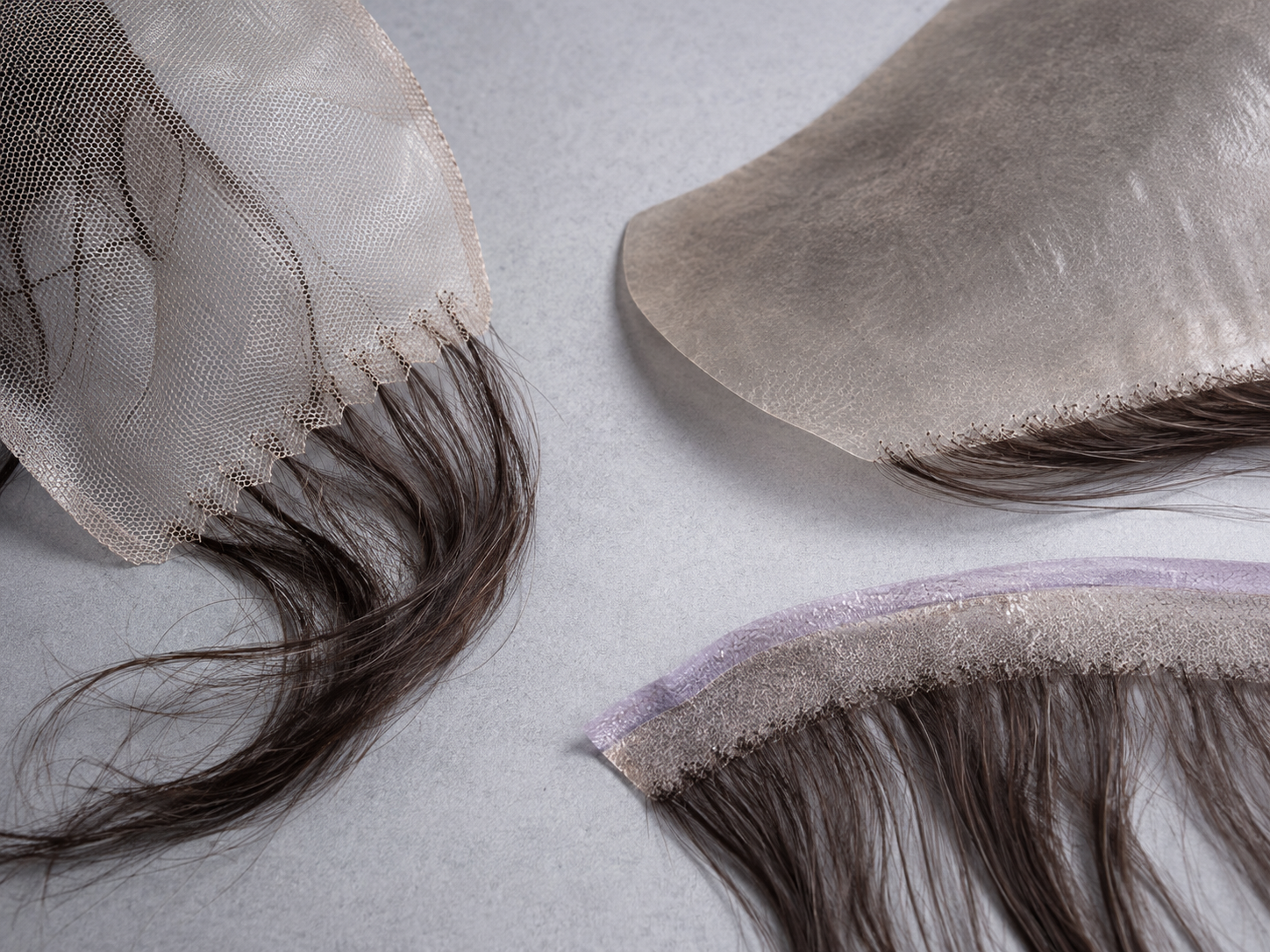
Choose thin skin when a smooth attachment surface and straightforward cleanup matter more than maximum airflow. Choose lace when breathability and a delicate exposed hairline are priorities and you can handle gentler maintenance. Choose hybrid when you want to balance lace airflow with easier-to-attach poly areas. Construction varies, so compare the exact model—not only the category name.
Easy-to-see adhesive area, convincing scalp effect, less ventilation.
Air passes through the mesh, but cleanup and handling require care.
Combines materials, often lace in the center or front with poly around selected edges.
Side-by-side comparison
| Factor | Thin skin / poly | Lace | Hybrid |
|---|---|---|---|
| Airflow | Lowest of the three | Usually highest | Depends on lace area |
| Hairline | Smooth, scalp-like transition when very thin | Fine mesh and knots can look subtle | Depends on front construction |
| Cleanup | Smooth surface is often easier to wipe | Adhesive can enter mesh | Poly zones may simplify attachment |
| Handling | Very thin models can tear or stretch | Fine lace needs gentle removal | Perimeter can add structure |
| Heat and sweat | Can feel warmer | Best starting point for airflow | Middle ground |
| Beginner fit | Often approachable for attachment and cleanup | Better for patient, careful handling | Can be beginner-friendly if the layout matches the routine |
| Current product example | The Hair NG — $199 sale | Superhairpieces M105 — $279 | Lordhair Neo — from $339 |
Example prices checked September 6, 2026. Promotions, stock, color, size and customization can change the final price; these examples do not prove that one base type is always cheaper.
Some product links on this page are affiliate links. If you buy through them, we may earn a commission at no extra cost to you. Recommendations are based on published specifications, not paid placement.
What is a thin-skin hair system?
A thin-skin system uses a transparent polyurethane base. Hair may be injected, V-looped or knotted depending on the model and area. The smooth film gives tape or liquid adhesive a clear surface and can create a close scalp-like appearance.
Where thin skin works well
It is a strong starting point for people who want a simple visual attachment area, an exposed hairstyle and cleanup that does not involve working adhesive out of mesh. The current LaVivid Upgrade Mirage, for example, is described as a 0.04–0.06 mm full-skin base with a V-looped front and a published lifespan of two to three months.
The tradeoff
Polyurethane does not allow air through the base the way lace does. People who sweat heavily, train frequently or live in hot climates may prioritize ventilation instead. “Thin” also does not mean indestructible: ultra-thin material can trade durability for a lower-profile edge.
What is a lace hair system?
Lace uses a fine mesh with hair tied into the material. Air and moisture can move through the openings, which is why lace is commonly positioned for warm weather and active routines. Swiss lace is generally finer and more delicate; French lace is commonly described as somewhat more robust. Those labels still do not tell you the density, knot treatment or perimeter construction.
Where lace works well
Choose lace when scalp ventilation is high on your list or you regularly expose the front. A carefully prepared lace hairline with appropriate density can be very convincing because there is no continuous film across the scalp.
The tradeoff
Lace asks more of the removal and cleanup routine. Adhesive can move into the mesh, and pulling too quickly can distort or tear fine material. A breathable base does not guarantee that an attachment method will tolerate every level of sweat.
What is a hybrid hair system?
A hybrid combines two or more base materials. A common design uses lace for airflow and a poly perimeter or sections that provide a smooth area for tape or adhesive. Another may use a lace front with skin around the sides and back. Always inspect the base diagram because two products called “hybrid” may behave differently.
Where hybrid works well
Hybrid construction can suit someone who wants more ventilation than full poly but does not want to attach directly to lace around the entire edge. It can also make sense when different parts of the base have different jobs—for example, a natural-looking front and a structured perimeter.
The tradeoff
A hybrid is not automatically the best of both worlds. It can also carry both sets of compromises: less airflow than full lace and more seams or construction complexity than full skin.
How to choose your base
Start with lace, then compare attachment guidance and maintenance—not just the mesh.
Start with thin skin or a hybrid with usable poly attachment zones.
Compare the exact front material, hair direction, density and knot or loop method.
A smooth poly surface may feel simpler, but repeated removal can still stress ultra-thin material.
Do not choose by base category alone. Adhesive, scalp chemistry, activity and care affect hold and lifespan.
Scalp tone and base color
A person’s visible scalp tone is the relevant detail. Compare sample material against the scalp in natural daylight and ask whether lace tint, poly color or knot appearance is available in a suitable shade. “Transparent” is not equally invisible on every scalp.
Hair color is a separate decision: it should usually blend with the surrounding hair, including gray percentage, texture and density. A correct hair shade cannot compensate for a base that contrasts strongly with the scalp at an exposed part or hairline.
Three common buying mistakes
- Choosing the thinnest base automatically. A lower-profile edge can come with more delicate handling and shorter service life.
- Treating “lace” or “hybrid” as a complete specification. The front, perimeter, knotting and density matter just as much.
- Ignoring the routine. A beautiful result that is too warm, too delicate or too difficult to clean is not a good personal match.
Frequently asked questions
Is lace always more natural than thin skin?
No. Both can create a convincing result. Lace can make an exposed hairline look subtle, while very thin skin can create a smooth scalp-like transition. Density, color, cut-in and installation also matter.
Which base is best for sweating?
Lace usually offers the most airflow through the base. Attachment method, scalp preparation and maintenance frequency still affect comfort and hold.
Is hybrid good for beginners?
It can be. A hybrid may combine a breathable area with a smoother perimeter for attachment. Check the exact layout and whether it simplifies the parts of the routine that concern you.
Turn the tradeoffs into a shortlist.
Answer eight practical questions about hairline, heat, maintenance, experience, scalp tone and budget. We will suggest a likely starting point and show products worth comparing.
Use the Hair System Finder →Lyrical Hair options to compare
Compare the exact construction and fit alongside the other brands; affiliate availability does not determine our recommendations.
- Lyrical Hair Ultra-Thin Skin — Skin / poly. Less ventilation than mesh; careful handling is important.
- Lyrical Hair Full French Lace — French lace. Adhesive can enter the mesh; cleanup needs patience.
- Lyrical Hair D7-3 Mono — Mono with poly perimeter. The listed 120–130% density may be too full beside fine surrounding hair.
Sources and methodology
This guide synthesizes current manufacturer specifications and product guidance. We have not physically wear-tested the systems named here.