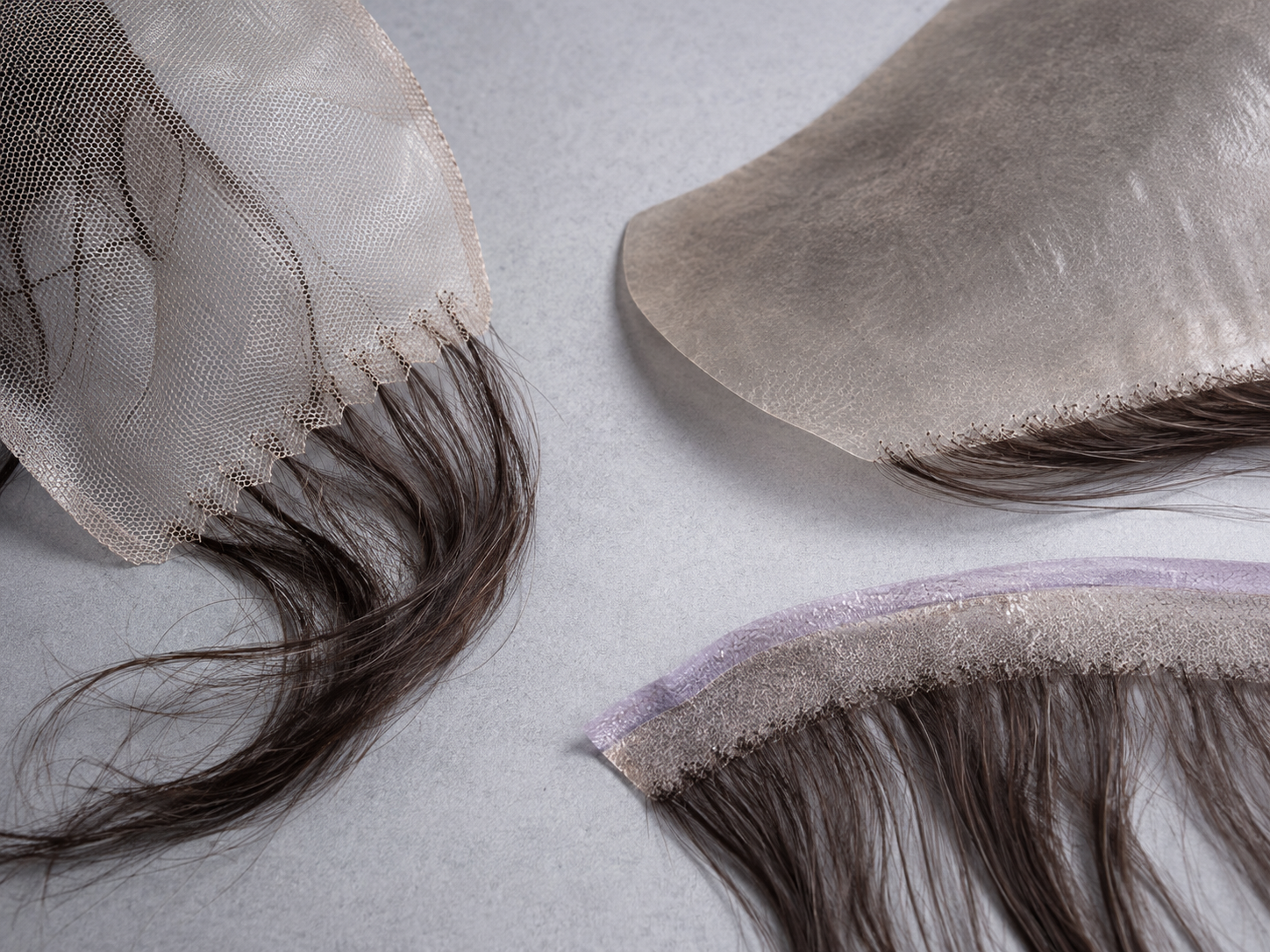
Many men's hair systems are described by manufacturers as lasting roughly one to six months. Ultra-thin skin and fine lace often sit at the shorter end because they prioritize an undetectable finish. Thicker poly, reinforced hybrids and mono constructions generally trade some delicacy for durability and may last longer. Your own result can fall outside any published range.
Typical lifespan by base type
The ranges below combine current guidance published by Lordhair and LaVivid. The companies do not always use identical definitions, so use them as planning ranges rather than a guarantee for a specific model.
| Base construction | Planning range | Main tradeoff |
|---|---|---|
| Ultra-thin skin (about 0.02–0.03 mm) | About 1–2 months | Highly discreet, but vulnerable to stretching, tearing and shedding |
| Thin or standard poly | About 2–4 months; thicker versions may reach 3–6 | Smoother cleanup and greater strength, with less airflow |
| Swiss lace | About 1–3 months | Fine and breathable, but needs careful removal and cleaning |
| French lace | About 2–4 months | Stronger than very fine lace while retaining airflow |
| Lace + poly hybrid | About 2–4 months | Balanced airflow and attachment; lifespan depends on the weakest zone |
| Mono or reinforced hybrid | About 4–6 months or longer | Built for durability, but usually less delicate than ultra-thin options |
“Lace,” “skin” and “hybrid” are broad categories. Two products with the same label may use different thicknesses, edge materials and ventilation methods. Always check the lifespan guidance for the exact model.
What actually determines lifespan?
1. Base thickness and construction
Very thin material can produce a subtle edge, but it leaves less material to resist pulling and repeated cleanup. Thicker poly and mono mesh are generally stronger. Hybrid durability depends on how its materials are arranged and where daily stress occurs.
2. How the hair is attached
Hair may be knotted, injected or V-looped into the base. Knotless methods can look extremely natural, but loose hair cannot regenerate after shedding. A stronger base does not guarantee a full appearance if the ventilation starts to fail.
3. Continuous wear and sleeping
Friction accumulates during daily wear and sleep. Pillows, hats and repeated brushing can dry or tangle the hair and stress the attachment points. A satin or silk pillowcase may reduce friction, but it cannot prevent normal wear.
4. Removal and adhesive cleanup
Pulling a system before the bond is properly released can stretch skin or distort lace. Heavy residue may encourage more forceful cleaning. Follow the instructions for the exact adhesive and base, use sufficient remover and work slowly from the appropriate edge.
5. Heat, sun, swimming and chemical processing
Human hair in a system does not receive natural scalp oils. Hot tools, UV exposure, chlorine, saltwater, frequent washing and strong products can accelerate dryness, fading and tangling. Light colors and processed textures may also be more vulnerable than less-processed hair.
Seven signs it may be time to replace the system
- Heavy shedding creates visible thin areas that no longer blend.
- Persistent tangling or dryness returns quickly after conditioning.
- Color fading or oxidation creates a noticeable mismatch.
- Torn or stretched skin changes the fit or attachment surface.
- Frayed or distorted lace makes the front difficult to place discreetly.
- Hairline deterioration remains visible after correct cleaning and attachment.
- Bonding becomes unreliable because the base itself is damaged—not simply because the adhesive or scalp preparation needs adjustment.
Why lifespan matters more than the sticker price
A $220 system replaced every two months costs about $1,320 per year before supplies and services. A $320 system replaced every four months costs about $960. This does not mean the longer-lasting option is automatically better: the shorter-life system may deliver the lighter hairline or comfort you value more.
Compare annual replacement cost, not only checkout price. Add cut-ins, adhesive, remover, shipping and maintenance supplies using our hair-system cost guide.
How to give a system a better chance of lasting
- Release adhesive fully before lifting the base.
- Handle wet lace and ultra-thin skin without pulling or wringing.
- Use care products suitable for human-hair systems and avoid unnecessary washing.
- Detangle gently from the ends upward while supporting the base.
- Limit high heat and rinse promptly after swimming.
- Store a removed system clean, dry and away from direct sunlight.
- Do not extend wear merely to reach a manufacturer estimate if the system no longer looks or feels acceptable.
Should you buy the longest-lasting base?
Not necessarily. Durability is only one axis. A wearer who exposes the hairline may accept a shorter lifespan for a finer front. Someone who prioritizes predictable cleanup or lower annual replacement frequency may prefer thicker poly or a reinforced construction. Hot-weather comfort may push the decision toward lace even when it requires gentler handling.
Use our base comparison to understand those tradeoffs, or answer the Hair System Finder for a likely starting point.
Frequently asked questions
How long does a hair system usually last?
Published estimates commonly span one to six months, depending on construction and care. Some reinforced mono or hybrid designs may last longer, while very thin disposable-style systems can need replacement sooner.
Does a more expensive system always last longer?
No. Price can reflect hair type, customization, density and construction—not only durability. Check the exact base and estimated lifespan rather than using price as a proxy.
Can rotating two systems save money?
Rotation spreads wear across two units and gives each time to be cleaned and dried carefully. It can extend calendar life, but the total value still depends on purchase cost and how each unit is handled.
Choose lifespan as one part of the decision.
Compare durability with airflow, hairline, cleanup, experience and budget before choosing a base.
Use the Hair System Finder →Sources and methodology
This guide compares lifespan estimates and care factors published by manufacturers. We have not physically wear-tested the systems or independently verified each lifespan claim. Actual results vary by model, routine and wearer.